By Vicki Valosik
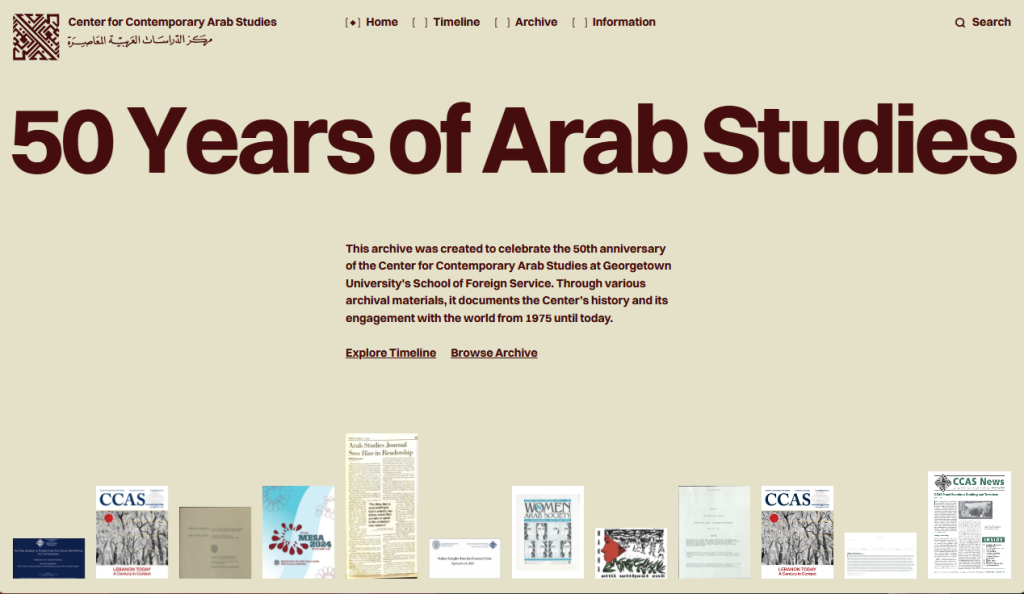
In January, CCAS marked its 50th anniversary with the public launch of a new digital archive—an interactive, multimedia timeline documenting the Center’s long legacy of teaching, research, and public engagement with the Arab world. Years in the making, the digital archive reflects an extraordinary collective effort to preserve and tell CCAS’s story. Drawing on videos, photographs, publications, oral histories, and other materials, it traces the Center’s evolution from its founding in 1975 through periods of expansion and change—while also capturing how the work of CCAS has helped deepen public understanding of the Middle East during critical regional and global events.
Work on the archive began several years ago under the leadership of CCAS Director Fida Adely and grew into a multi-year effort involving interns, students—both undergraduate and MAAS—alumni, faculty, and staff across CCAS, the Georgetown University Library, and CNDLS. In the project’s early days, interns and students began sorting through boxes of documents, photographs, recordings, reports, and ephemera stored at CCAS. Some materials hadn’t been handled in years, but as the team inventoried and organized them, those boxes became a map of the Center’s institutional life—revealing the people, programs, debates, and turning points that shaped CCAS over five decades.
With a growing body of material in hand, the work shifted from collecting to interpreting—the archivists deciding what story they wanted to tell and how. To tackle such a monumental task, the team began identifying major milestones across the Center’s five decades of history, along with the digitized materials that could best anchor and illustrate those developments. They conducted interviews and new research to fill in gaps and to situate developments at CCAS within the broader contemporary events they were responding to. With the milestone list expanding, the team faced difficult choices about what to include and what to leave out—drawing on Adely’s guidance and the institutional memories of former faculty and staff to keep the timeline curated and readable while preserving the Center’s defining moments.
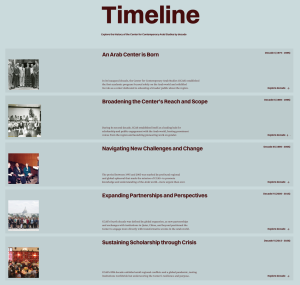
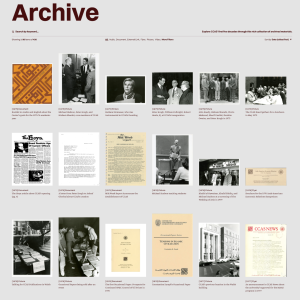
As the narrative took shape, the team partnered with web designers and developers based in Egypt to create a visually pleasing, online home for the milestones and digitized materials. The result is the new interactive archive website, which is now publicly available at https://ccasarchive.georgetown.domains/. The site is organized in two parts: a narrative timeline, divided by decade and built around nearly 100 curated milestone entries, and a searchable archive of more than 400 individual pieces of digitized material, each linked to the relevant milestone entries. Together, these materials and written narrative serve as a digital record of CCAS’s first fifty years. To Professor Adely, the archive—and the years of work that went into creating it—represents a labor of love. “When I suggested creating an archive, I could not have imagined what a rich, collaborative, and exhaustive project it would become,” she said. “The process of building the archive reflected the very best of what the CCAS community represents.”
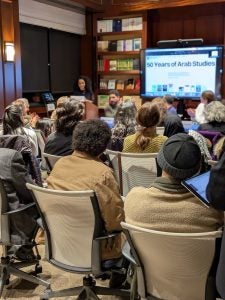
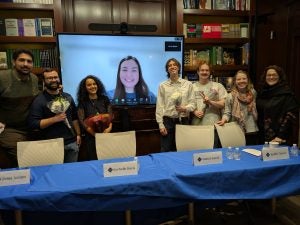
To debut the new archive, CCAS hosted a public launch on January 15. The event featured panelists from the archive team, as well as a cross-section of alumni, faculty, and former staff who worked or studied at the Center at different points in its history. Professor Adely opened the evening by discussing how the archive evolved and thanking the contributors who helped bring the project to life: alums Ali Tohamy and Shifaa Alsairifi; MAAS students Jasper Hunsinger, Ian DeHaven, and Layth Malhis; undergrad students Olyvia Lennox (who graduated last May) and Ava Zebelski; Georgetown’s Middle East Studies Librarian Ryan Zohar; and CCAS Editorial Director Vicki Valosik. She also thanked Aramco, a longtime supporter of CCAS’s public engagement and educational outreach efforts, for critical financial support that sustained the project.
After Adely’s opening remarks, Shifaa Alsairafi, the archive project manager, gave the audience a tour of the new website, noting that that team had catalogued more than 1,600 items before ultimately deciding which ones would be included in the final archive. Alsairifi was then joined by several members of the archive team, Tohamy, Lennox, Zohar, Hunsinger, and DeHaven, who discussed what the project meant to them, as well as some of the practical challenges of building a timeline that fairly and accurately represented five decades of the Center’s history. Zohar, who coordinated the Library’s role on the project, noted that beyond the more visible effort of research and writing that went into creating the archive, many more hours of unseen legwork by the team and others were needed to get the website across the finish line. “A project like this involves a lot of behind-the-scenes labor—metadata, scanning, troubleshooting, more troubleshooting—and very little of it is glamorous, but all of it is essential,” said Zohar.
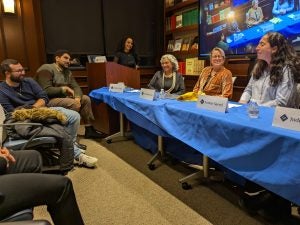
The second panel stepped back from the making of the archive to reflect on the history it documents. Speakers representing each decade of CCAS’s first fifty years—Former Director of Education Outreach Zeina Azzam (Decade 1, 1975–1985), Professor Emerita Judith Tucker (Decade 2, 1985–1995), MAAS alum Bassam Haddad (Decade 3, 1995–2005), Professor Rochelle Davis (Decade 4, 2005–2015), and MAAS alum Samar Saeed (Decade 5, 2015–2025)—offered snapshots of the Center’s evolving culture as well as its major initiatives and contributions across their respective eras. Their conversation ranged from why CCAS’s founders saw the need for a center devoted exclusively to the Arab world to how the Center expanded its scholarly and public engagement with the growth of the MA in Arab Studies (MAAS) program and education outreach, as well as through responses to critical events such as September 11 and the Iraq War. You can watch a video from the launch event on the CCAS YouTube channel.
Although the evening centered on the launch of a new digital resource, it—much like the archive itself—served as a tribute to the community that built CCAS and has sustained it across generations. “This digital archive isn’t just about marking 50 years on a timeline,” said Zohar. “It’s a reminder that centers like CCAS are built not just through scholarship, but through people, relationships, and sustained connection over time. It’s about preserving institutional memory, surfacing voices and moments that might otherwise be lost, and making the history of CCAS accessible to future students, scholars, and community members.” In addition to the digital archive, CCAS will mark the anniversary with an exhibit at Lauinger Library in April, featuring physical materials curated by Zohar and members of the archive team.
For Alsairafi, who graduated from MAAS in 2024, managing the digital archive project and learning first-hand how much CCAS has helped shape the study and understanding of the Arab world carried personal meaning. “Encountering this history as a student of the region made me feel part of something far greater than myself,” said Alsairafi. “As the saying often attributed to Imam Ali reminds us, ‘Do you think you are a small entity, when within you lies the entire world?’ We carry the histories and legacies of those who came before us as we move through the MAAS program and beyond, and this archive brings into focus exactly what that greater world entails.”
Vicki Valosik is the CCAS Editorial Director.