
MAAS Students Launch New Podcast
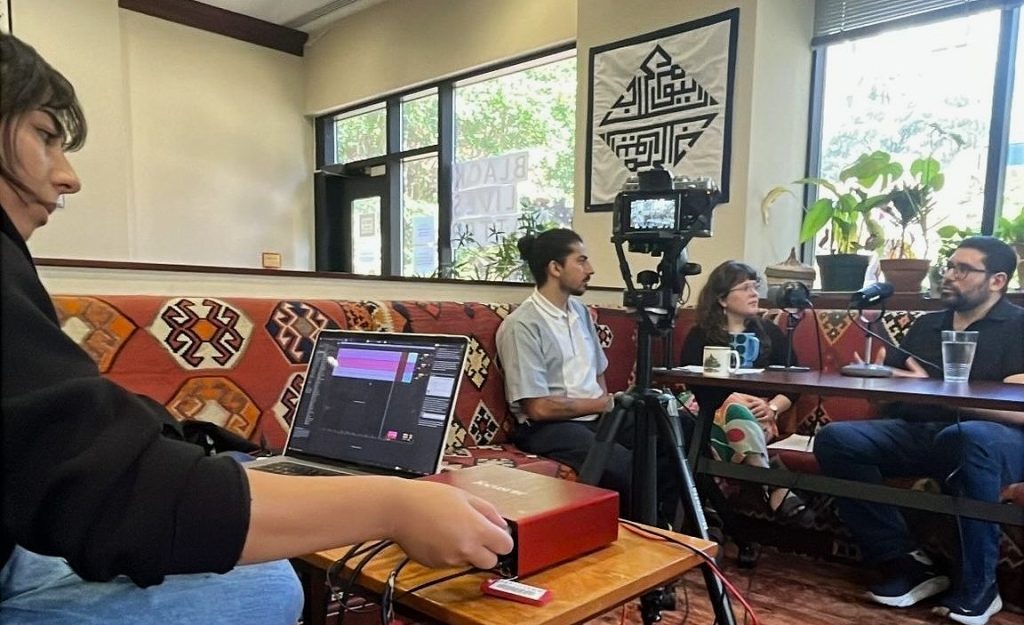
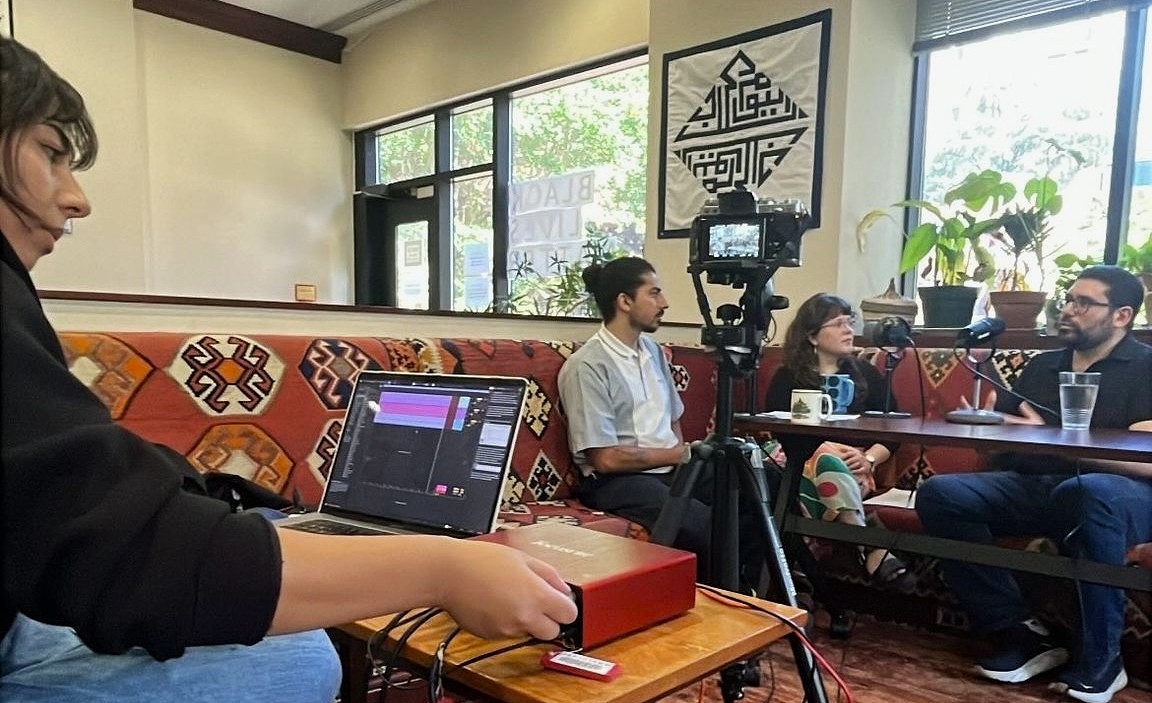
Amina Darabie, Michel Sindaha, and Lauren Burns conducting an interview for Shu Kaman? with scholar Jehad Abu Salim
A new student-led podcast, Shu Kaman?, delves beyond the surface with scholars and students of the Arab world.
By Hanane Idihoum and Layth Malhis
Within the first month of our time as students at the Center for Contemporary Arab Studies, we found ourselves in rooms with some of the sharpest voices working on the Arab world today. Hearing people like Francesca Albanese, Maya Wind, Aomar Boum, Diana Buttu, Maya Mikdashi, and others speak week after week made it clear that CCAS is not a typical academic space. The Center hosts some of the most critical and unapologetic voices on the region, voices that students at most universities do not have regular access to. We quickly realized how lucky we were to be students at a place like CCAS.
After several months of reading the work of scholars and attending their talks—sitting in the CCAS conference room and spending long hours in Copley Hall—a question began to surface among us. Why were these conversations staying confined to the Center and its immediate academic community? We felt a responsibility to speak to a broader audience that extended beyond the university’s walls, especially when so many of the ideas shared at CCAS felt urgent, timely, and relevant far beyond Georgetown. We also wanted to make the figure of the “academic” more approachable, and to decenter the prestige brought with Western academia that often distances people from engaging with scholarly work. We wanted to know the scholars we read beyond their publications and to hear the stories and experiences that never make it into formal talks. We were curious about what keeps them committed to this work, why they continue to write and speak so forcefully about the region, and, importantly, what sustains them in the face of constant distortion and violence.
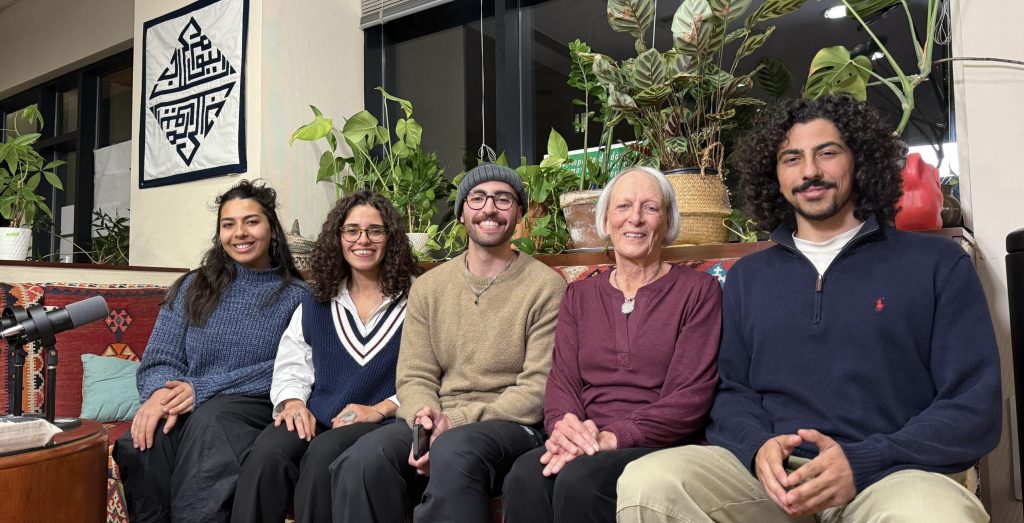
Amina, Hanane, Layth and Michel after recording an episode with CCAS Professor Emerita Judith Tucker
That reckoning led to the launch of a new student-led podcast, Shu Kaman? A podcast felt like the best platform to circulate the knowledge we were receiving at CCAS and to reach people far beyond academic spaces. It allowed us to extend the life of the conversations happening here and to invite others into them, wherever they might be. The podcast’s name gestures towards this spirit. Shu Kaman?, which translates to “what else?” in Arabic, is a common colloquial interjection used to push a conversation forward or convey frustration or impatience. Amina Darabie, Shu Kaman’s production manager, says that one of the main goals behind the podcast is “to ensure that knowledge about the region circulates freely, rather than remaining trapped behind paywalls or reserved for those with access to graduate education. By sharing these conversations, we hope to spark curiosity in our listeners, whether they are already well-versed in our topics or encountering them for the first time.”
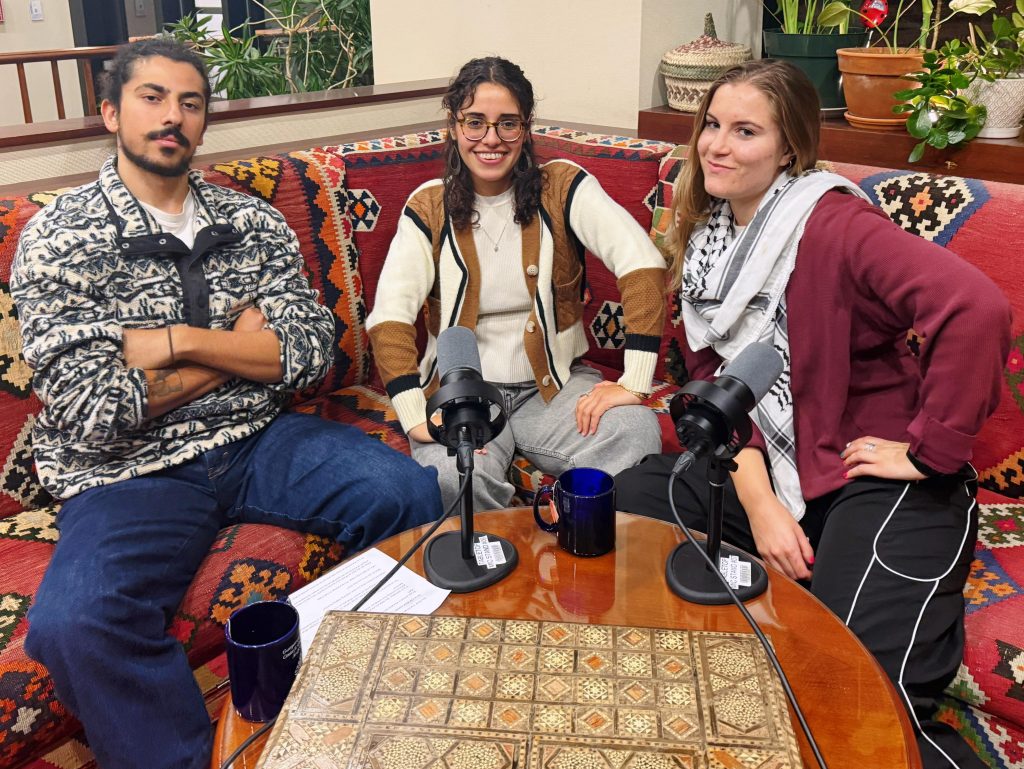
Michel and Hanane interviewing MAAS student Chloe Daikh for a Student Corner episode
As we launch our second semester with Shu Kaman?, we have recorded interviews for 11 episodes so far, with guests including Judith Tucker, Muriam Haleh Davis and Sami Hermez. For Darabie, it is especially rewarding to be able to have extended conversations with scholars whose work she has read in class. “For me, the best part has been hearing about the experiences our guests have had, the moments that shaped them, which are often left out of article introductions or public talks,” she says. “That is what makes Shu Kaman? so special.”
The idea for Shu Kaman? first came about in the Center’s colorful diwan. After some encouraging words from Professor Rochelle Davis, a few invigorating conversations and a lot of legwork from a dedicated team, our vision solidified and then quickly materialized into the project it is today. Each of us brought something distinct that helped form a professional production team. Amina brought visual, audio, and technical expertise as the production manager. Layth Malhis, our operations manager, brought structure and logistical coordination between guests and faculty. Together, the team was anchored by its two co-hosts, Michel Sindaha and Hanane Idihoum, whose approaches to conversation shaped the tone of Shu Kaman? The first two episodes were co-hosted by Michel and Lauren Burns. Lauren, a talented filmmaker, stepped away to work on personal projects, and Hanane joined to complete the team.
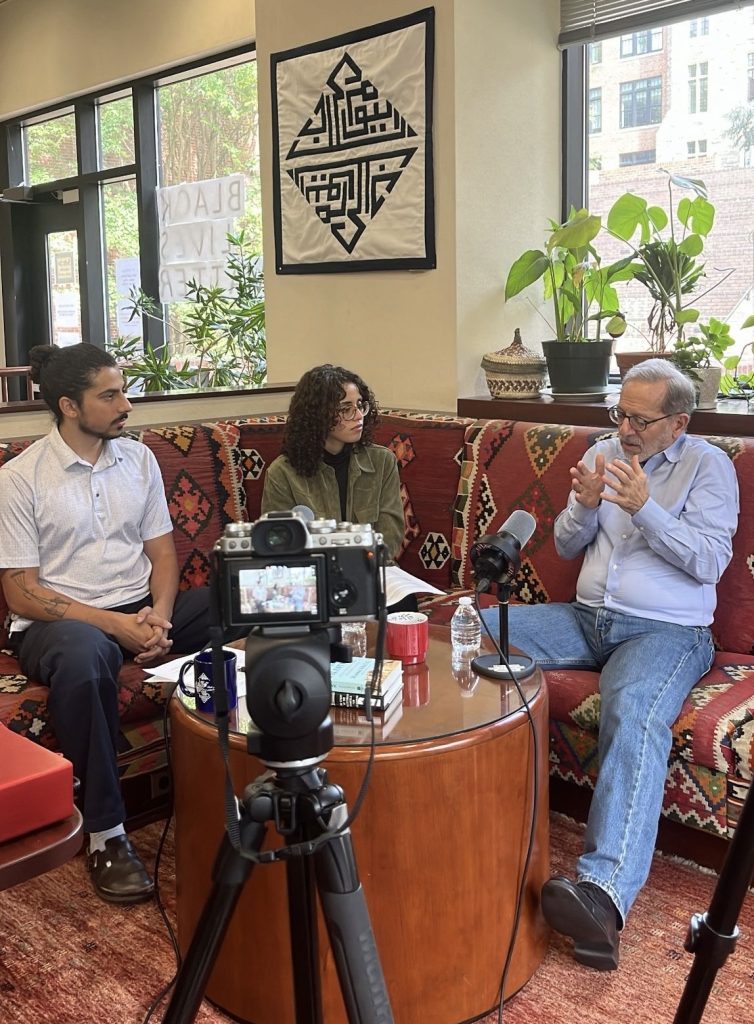
Michel and Hanane interviewing scholar Rashid Khalidi
Just as the idea was born there, we chose to record in the diwan intentionally because that is the heart of CCAS and reflects the life of the Center better than any formal recording studio ever could. The diwan is not only where students study, chat between classes, decompress, and share coffee or tea—it is also the place where students debate ongoing issues and continue unpacking readings that resonated with all of us. Because of this, we knew from the beginning that students would have a voice on Shu Kaman? alongside established scholars whose work has shaped the field. Our classmates are already producing serious, critical work on the region, and we wanted to highlight them through the podcast’s “Student Corner” series where we sit down with MAAS students and hear about their research and work in and outside of CCAS. Our posting schedule alternates between guest scholar and Student Corner episodes.
For Michel Sindaha, co-host of Shu Kaman?, one of the most challenging and thrilling moments with the podcast so far was an interview with renowned scholar Rashid Khalidi, who delivered the 2025 Kareema Khoury Memorial Lecturer at CCAS last October. Between arranging the logistics, securing a videographer, and the actual research and interview preparation, the crew spent months preparing for their evening with Professor Khalidi, said Sindaha, “so seeing this veteran historian walk through the doors felt like a triumph in itself.” When taping for the episode—which aired this January—ended and Professor Khalidi left the building, Sindaha recalled, “we found ourselves breaking into a celebratory dance. It was exhausting and difficult, but these were exactly the kinds of experiences I came to CCAS seeking.”
Despite the work, Shu Kaman? has provided an outlet to connect with the region from afar at a time when the current political climate is driving us further apart. In the midst of genocide, dispossession, political collapse, and fragmentation across the Arab world, the podcast has held onto something essential: care for the region, emotional investment, and intellectual commitment —and shown that these do not disappear under pressure. Our guests, students and scholars alike, have demonstrated through their words and actions that even in times of calamity, love for the region and its people remains stronger than the forces that seek to divide and dehumanize us. That love is what Shu Kaman? came out of, and what it continues to hold.
You can listen to Shu Kaman? On Youtube, Spotify and Apple Podcasts. You can also follow-us the podcast on Instagram page for the latest updates.
Hanane Idihoum and Layth Malhis are both second-year students in the MAAS program.