
More Than Advisors
How the CCAS advisory board has helped sustain, strengthen, and expand the Center over five decades
By Vicki Valosik
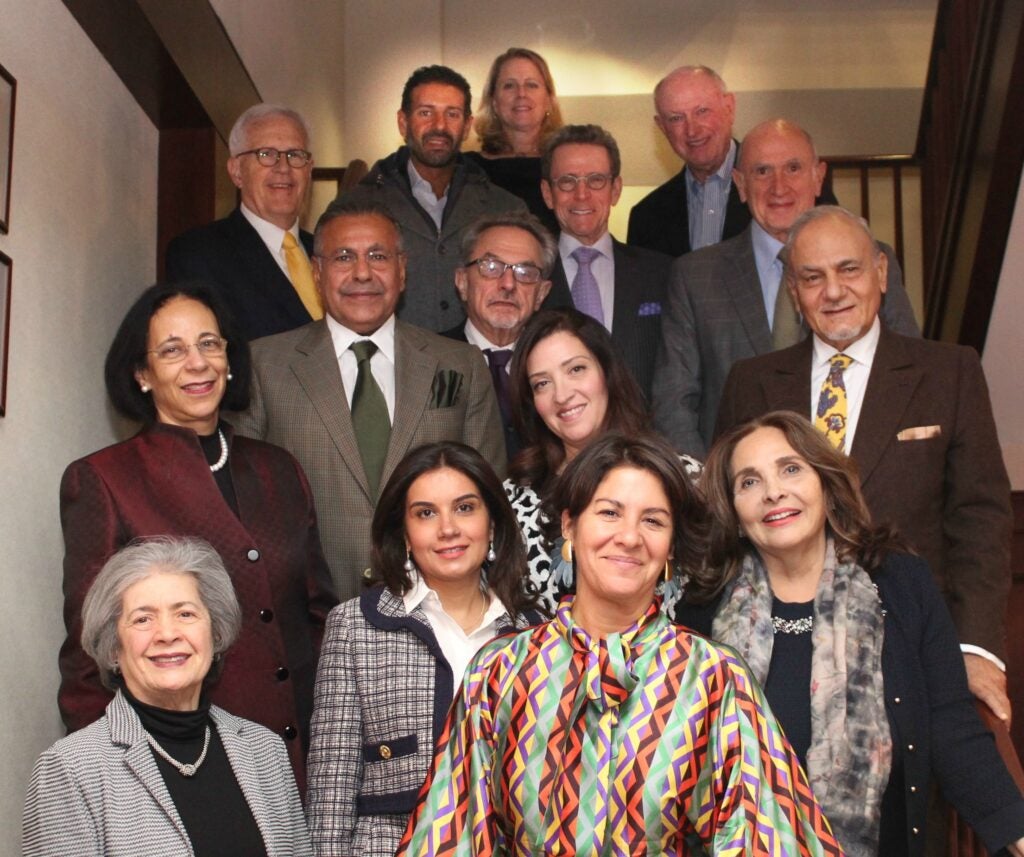
The Board of Advisors in 2019 with then-Chair Laurie Fitch on the front row, second from right
As the Center for Contemporary Arab Studies marks its 50th anniversary, much of this year’s reflection has centered on the faculty, students, alumni, and staff who have shaped the Center from within and built its intellectual life over five decades. But the history of CCAS is also, in important ways, a history of the Board of Advisors, whose members have helped extend that work outward through strategic guidance, financial support, institutional partnerships, and ties to the Arab world.
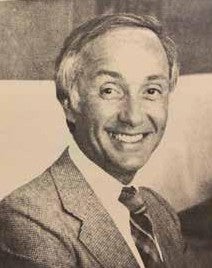
Ali Ghandour, the first chair of the CCAS Advisory Board
From the beginning, the board was conceived not as a ceremonial body but as an active partner in the Center’s growth. Its first chair, Ali Ghandour—an aeronautics engineer, president of Alia Royal Jordanian Airlines, and noted supported of human rights in the region—set that tone early, bringing to CCAS the stature that would come to define the board’s role. Over the years, its members have included ministers, senior diplomats, legal and business leaders, philanthropists, entrepreneurs, and many others. They have lent expertise and opened doors, given generously to support CCAS programming and administration, and helped connect Center leadership to institutions and donors across the Middle East and beyond. Their support for students has taken the form of numerous scholarships, including both endowed funds and those established in response to urgent needs. Most recently, during the war on Palestine, board members mobilized to help raise support for students from Gaza to come to the United States and pursue graduate study in the MAAS program.
The board’s support has shaped not only the work of the Center, but also the place from which that work has unfolded. In 1995, while Nemir Kirdar was serving as board chair, CCAS moved into its new home in the Edward B. Bunn Intercultural Center, featuring a boardroom, staff and faculty offices, and a diwan-style reception area featuring large windows and kilim-covered sofas. The move was made possible through a $2 million investment from Investcorp, the firm Kirdar founded, along with an additional $200,000 contributed by other board members—a tangible example of the board’s role in helping build the institutional foundations for CCAS’s future.
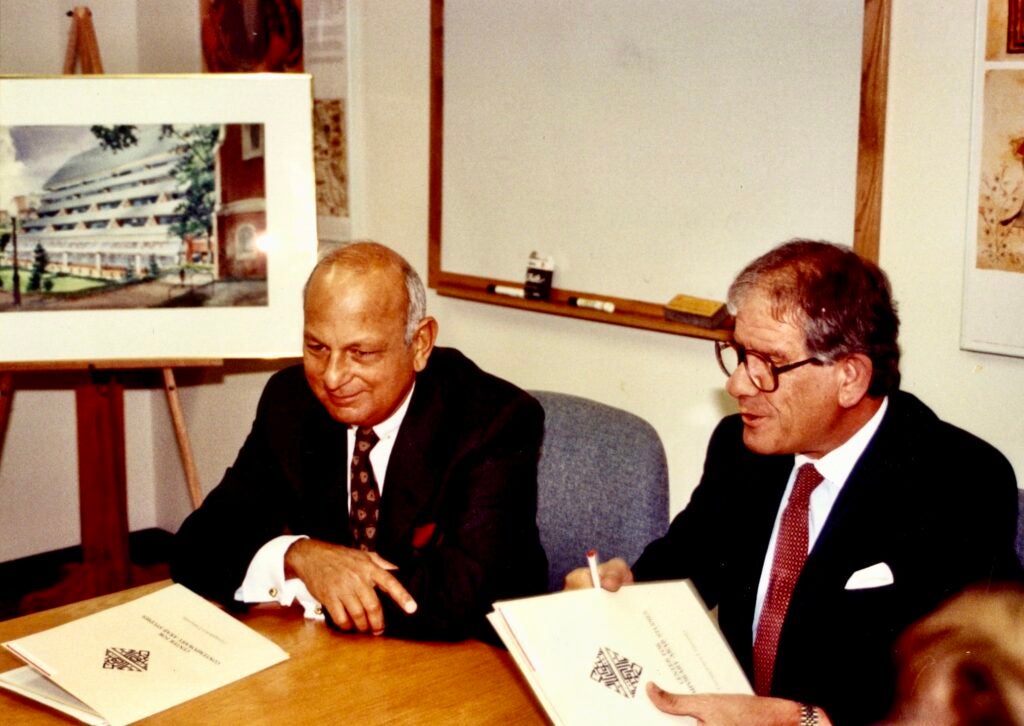
Former Chair Nemir A. Kirdar and Professor Ibrahim Ibrahim discuss plans for CCAS’s new suite in the ICC.
What has distinguished the CCAS board is not only the stature of its members, but also the depth of their commitment to the Center. Many have served for years, bringing continuity and institutional memory, and in some cases that commitment has extended across generations, with multiple members of the same family serving on the board. Several MAAS alums have served as well, including Ambassador Lina Annab and former chairs David Jackson and Laurie Fitch, reflecting the lasting ties our graduates continue to feel to CCAS. Institutional partners have also played an important role. Aramco, for example, has supported CCAS for many years and has long maintained a representative on the board. Fitch, who stepped down as board chair in 2025 after a decade of service, has spoken about the importance of both these long-serving members and bringing in new ones, and during her tenure she worked to expand the board in that spirit, including recruiting current chair Ali Farouki.
Fitch, a retired partner of PJT Partners, originally joined the board in 2014 as a way to support a Center that had a “profound impact” on her. “Being on the board is a way that I’m able to help further the mission, help deepen the mission, and help other students benefit from the Center, as I did,” said Fitch. Although she has endowed a scholarship fund and supported numerous other student-focused initiatives at CCAS, Fitch sees it not so much as “giving back” as paying it forward—helping future MAAS students pursue the same kind of elite education that shaped her own life.
Beyond the philanthropy of its individual members, Fitch sees the board’s larger role as “twofold”: to push faculty and University leadership to make the Center “as impactful as it can be through strategy and execution,” and to help secure the funding needed to support that vision. That is why, as chair, she made endowing the Center itself a central priority, backing that effort with a $1 million pledge. She sees full endowment, which would provide permanent, sustainable funding, as essential to CCAS’s future because it would safeguard its most important programs while providing, in a word, “independence.”
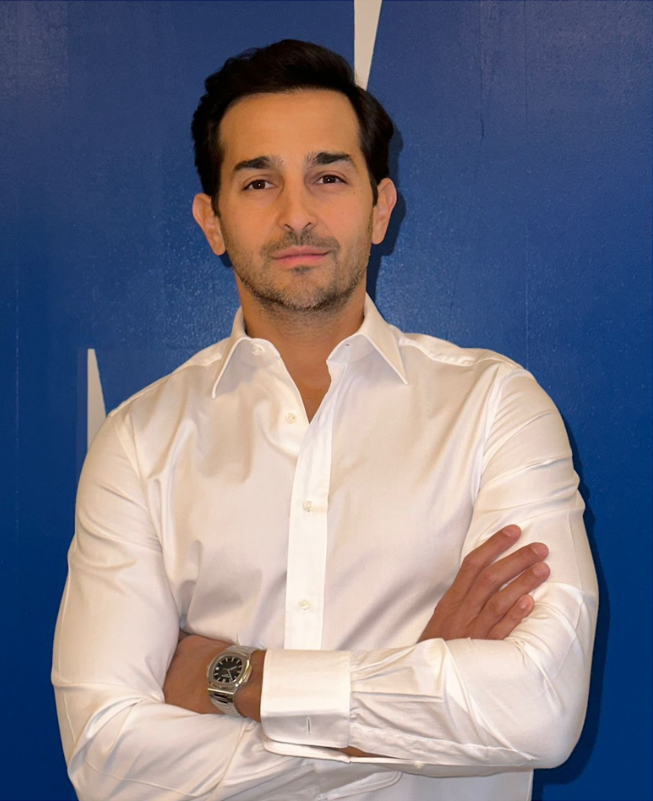
Ali Farouki, who became chair of the CCAS Board of Advisors in 2025
Ali Farouki, who succeeded Fitch as chair and is CEO and Director of Sanad Holdings Limited, is now carrying that effort forward, with full endowment as his central goal. “Fifty years of remarkable work,” he wrote, “deserves a foundation that ensures the next fifty are defined by ambition, not limitation.” He describes the board as “a force multiplier for the Director and faculty,” one that can bring “networks, resources, and perspective” to support the Center’s mission. For Farouki, that mission begins with the Center’s distinctive focus on the Arab world and the depth of its scholarship and impact. “The Arab world is home to over 400 million people and sits at the intersection of some of the most consequential dynamics in global affairs,” he wrote. “Having a center of this caliber dedicated to understanding and teaching it accurately feels more important now than ever.”
In 1985, on CCAS’s tenth anniversary, Ali Ghandour wrote that the Center’s “commitment to the future remains great and we cannot rest on our laurels.” Over the decades, the board has carried that spirit forward, its members using their experience, influence, and resources to strengthen the Center and extend its reach. Fifty years on, their work remains essential.
Vicki Valosik is the CCAS Editorial Director.