
Looking Forward: The Next 50 Years
CCAS faculty reflect on their hopes for the future of CCAS and the field of Arab studies
Fida Adely
CCAS Director, Associate Professor of Anthropology, and Clovis and Hala Salaam Maksoud Chair in Arab Studies
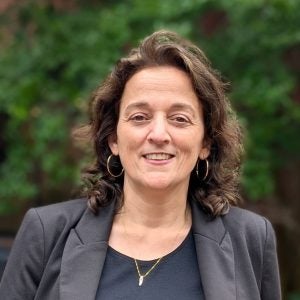
We mark this 50th Anniversary milestone during some of the darkest days the Arab world and its peoples have faced in our recent history. The violence of ongoing Israeli occupation, imperial wars, economic inequality and political instability continue to wreak havoc on the region, its neighbors and peoples. In just the past few years, millions have been displaced and hundreds of thousands killed—in Iran, Lebanon, Palestine (especially Gaza), and Sudan. At the same time, international humanitarian and rights regimes have been decimated, leaving us all vulnerable to a world with no accountability.
While it is easy to feel despondent, I continue to take courage and a sense of purpose from those who persevere despite these atrocities: those on the ground who insist on documenting war crimes and everyday injustices, on treating the wounded and healing the sick, on recording people’s narratives and memories, on teaching and maintaining intellectual life under the most grave conditions.
CCAS will persevere as well. We remain committed to producing and disseminating knowledge of the region grounded in the diverse experiences and intellectual contributions of its peoples. We remain committed to preparing young scholars and professionals for ethical engagement with the region and to working for justice for all people. This mission has never been more critical. As we look ahead, the challenges are many, but the vibrancy of our community—our students, alumni and faculty and our people on the ground struggling for dignity, for love, and for life—keep us focused on this mission. In a time of great instability, injustice, and repression, we remain committed to knowledge production that speaks truth to power and to protecting spaces for critical debate and dialogue in our university.
Mohammad Alahmad
Assistant Teaching Professor
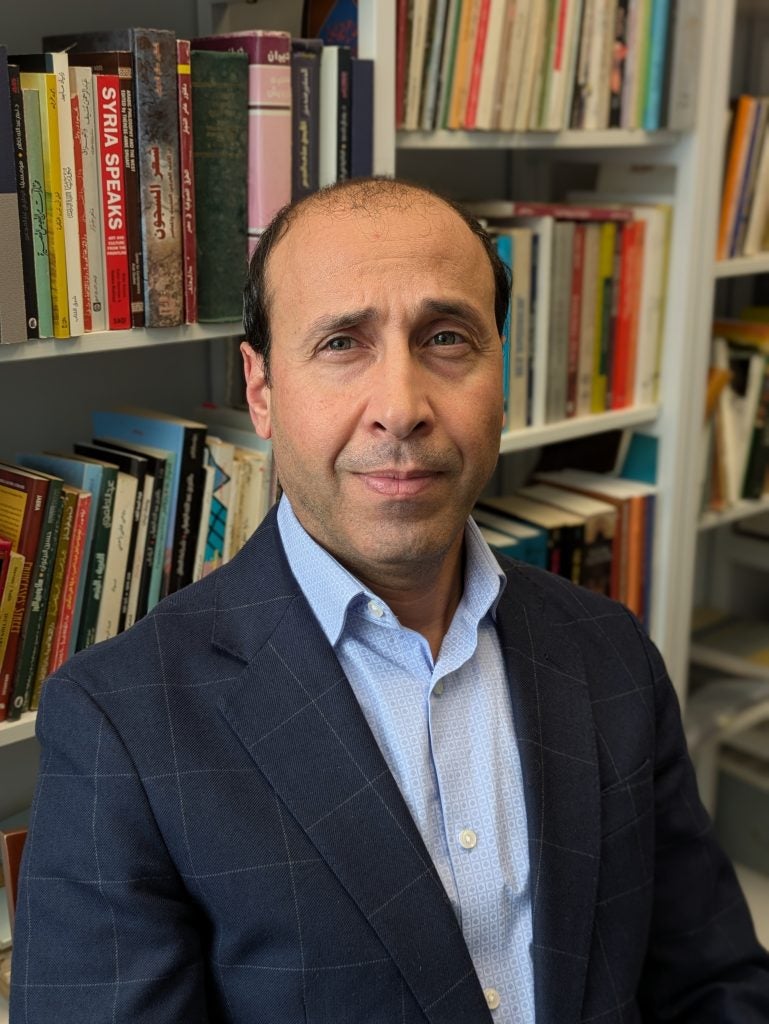
As CCAS celebrates its 50th anniversary, I find myself returning to what it has meant to me since the fall of 2015: far more than an academic home. CCAS is something rarer—a place where the human and the academic are profoundly joined. That, to me, is the true story of CCAS.
I came to CCAS through one of the darkest chapters of my life. Back in 2015, while living in northeastern Syria under the constant threat of death—whether at the hands of ISIS or under bombardment by the Assad regime —I submitted an application to the Institute of International Education’s Scholar Rescue Fund fellowship, which a yearlong fellowship enables threatened scholars to continue their work in safety and dignity. When I learned that I had been awarded the fellowship and would join CCAS as a visiting professor, what moved me most was not only the fellowship itself, but the fact that CCAS had chosen to become a partner in such a program because it believed in its purpose and in the humanitarian mission at its core.
That commitment was not only institutional; it was also deeply personal. One of the people who helped my family and me secure our visas was a graduate of CCAS working at the U.S. consulate. Her help was not separate from the story of CCAS, but an extension of it. She, too, carried forward the values she had learned there: that scholarship is not only about knowledge, but also about human responsibility. For the past ten years, I have seen this same spirit at the heart of CCAS. It is a place where research and teaching are never fully separated from care, solidarity, and moral purpose. My own story is only one example. There are many others whose lives have been changed by CCAS, often in ways deeper and longer-lasting than any professional achievement alone can measure.
Killian Clarke
Assistant Professor of Political Science
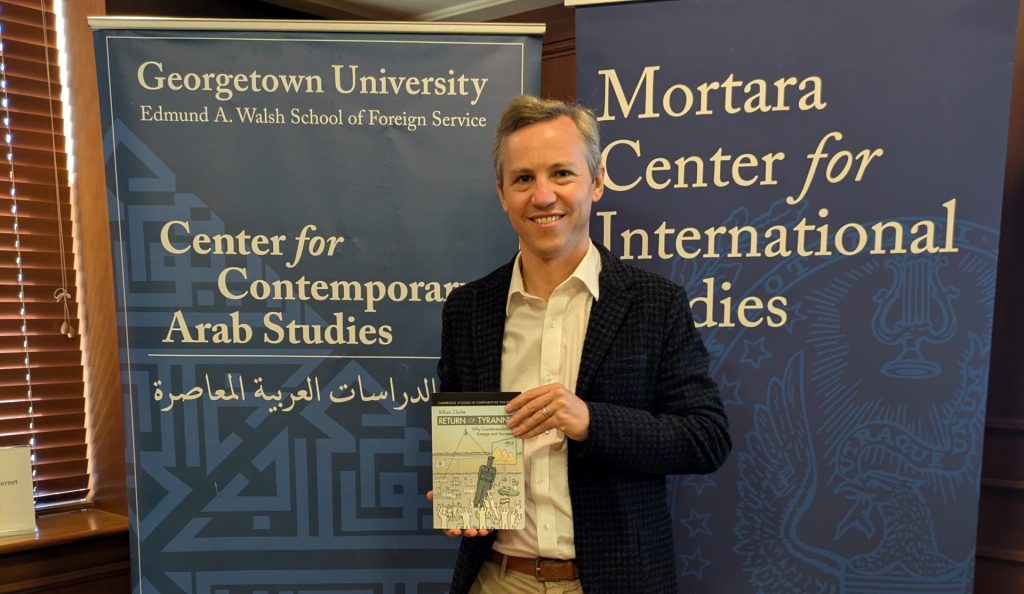
Our 50th year anniversary offers a moment for celebration, and also for reflection about the future of Arab studies. This is especially true because the timing of this anniversary coincides with a moment when Middle East studies—and area studies more broadly—is at a critical juncture. Attacks and retrenchments by the federal government have coincided with broader questioning across higher education about the value of area studies and foreign language training. At this moment, then, it is all the more important to embrace and re-invigorate our mission, so that we can offer another fifty years of engaged, rigorous, and ethically-informed research and training on the Arab world. This means supporting our faculty across multiple disciplines to pursue cutting-edge research and generate knowledge that informs public and scholarly debates. This means innovating and building on the strength of our Master’s program, so that we are educating many future generations of students in the skills they need to work in and on the region in a rigorous and principled manner. This means maintaining world-class Arabic language training, so that our students can communicate seamlessly with those who live in the Arab world. And this means diversifying and broadening our sources of institutional support, so that we can maintain a robust and independent program of events and research activities. Middle East and Arab studies are at an inflection point – but I am hopeful that with the right effort and investment, our Center can be at the forefront of ensuring that these projects thrive for another fifty years.
Marwa Daoudy
Director of Graduate Studies, Associate Professor of International Relations, and Seif Ghobash Chair in Arab Studies
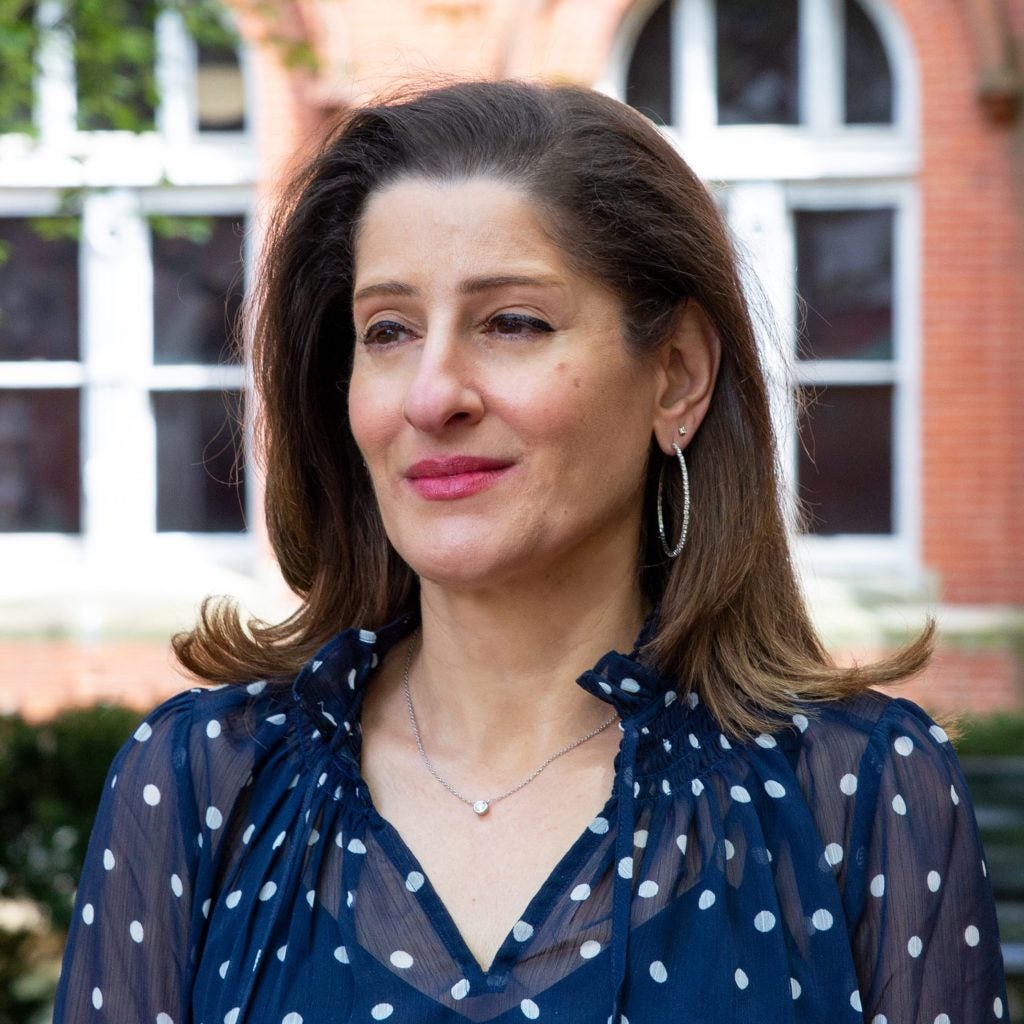
CCAS will continue to project itself as both an institution and a method. It is a site where intellectual work is shaped by commitments to language, history, and lived experience, but also a model for how scholarship remains politically engaged. Our mandate is best understood as a living intellectual tradition, a set of enduring commitments to critical inquiry, to solidarity with the people in the region, to production of knowledge that challenges dominant hierarchies and supports resistance against injustice and oppression. We strive to continue to offer alternative epistemologies and methodological tools that not only resist dominant narratives but also amplify the voices and histories of Arabs and other communities in the region, while honoring their deep-rooted connection to their land, their history. By linking past intellectual traditions to present imperatives and future possibilities, Arab Studies will remain a vibrant space for imagining alternative futures. Knowledge production becomes an act of witnessing, preservation, and refusal, the refusal of erasure, of dehumanization, and of narratives that obscure structural violence.
Rochelle A. Davis
Associate Professor of Anthropology and Sultanate of Oman Chair
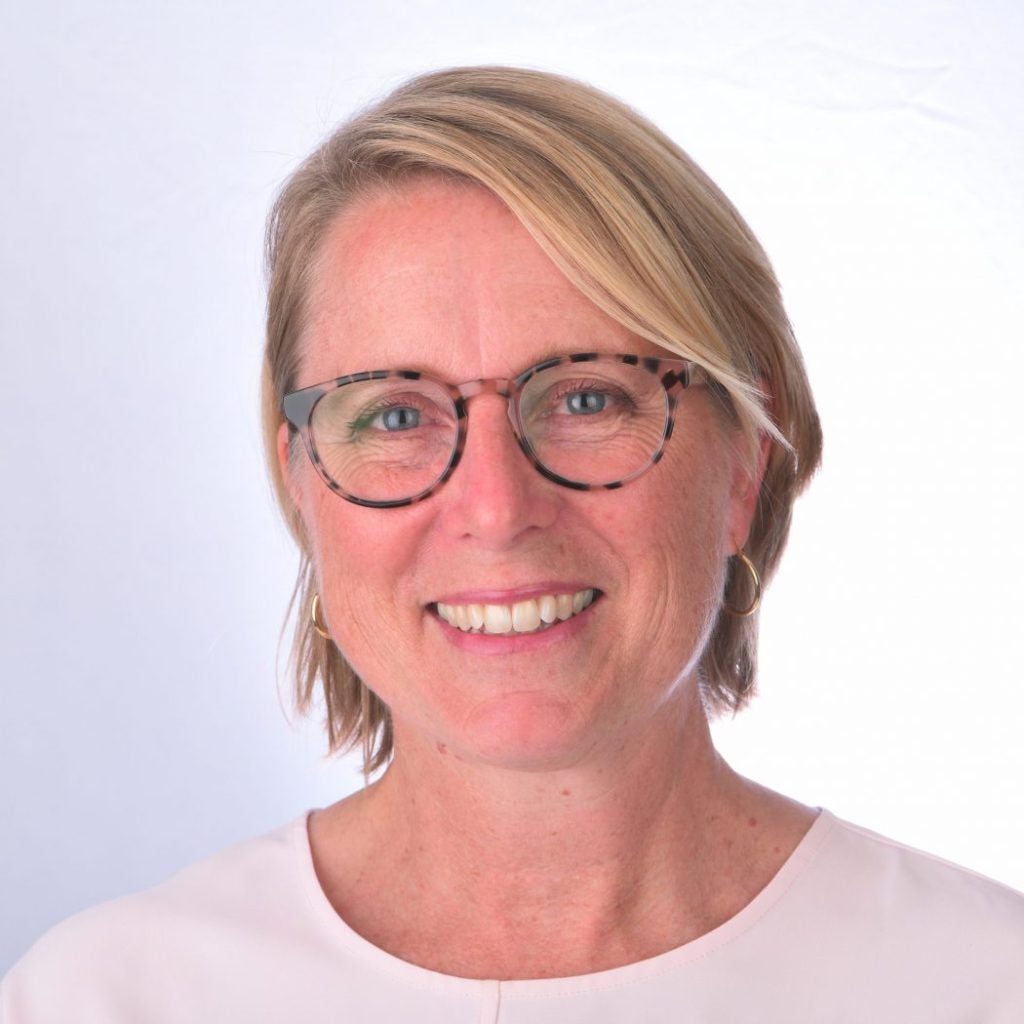
My research focuses on war, displacement, and refugees, and thus my vision of the future is one tainted by the growth of violence, US Empire, and repressive fascism. The 21st century has seen endless American wars in southwest Asia, funded by American tax dollars and in some cases supporting proxy militias or governments. These wars, and internal conflicts have resulted in massive displacements of Iraqis, Syrians, Palestinians, Sudanese, Yemenis, and Lebanese, along with others who have found refuge in the Arab world.
I fear the increasing militarization of US foreign policy and of the Arab World also comes with an economic cost that benefits some and impoverishes many others. The Brown University Costs of War Project estimates US military spending from 2001-2022 at $8 trillion dollars, much of it funded by debt unlike previous wars. Since those statistics were collected, American military support for the Israeli genocide of Palestinians has added $21.7 billion in just 2.5 years. Some might argue that military spending builds the American economy. But according to a 2025 paper by economist Heidi Peltier, military spending, both direct jobs and in the supply chain is worse for job creation than other industries: military spending (5 jobs per $1 million in spending); education (13 jobs for $1 million in spending); healthcare spending (9 jobs per $1 million); and infrastructure and clean energy (6-8 jobs per $1 million in spending).
This militarization of governmental budgets also exists in the Arab world: the World Bank data shows that of 20 states that spend 4% or more of their GDP on their militaries, 10 of those are Arab states. Weapons and militaries don’t build; they destroy. They don’t produce; they destabilize and rupture. There has been incredible educational and economic growth in parts of the Arab world. But, as I look to the future, I see a global leadership more willing to spend on destructive violence, rather than on human security. Without significant change in the coming years, global leadership is failing to support our children, human well-being, and the health of the planet, a failure that puts in jeopardy the advances made in the last 50 years.
Noureddine Jebnoun
Adjunct Professor
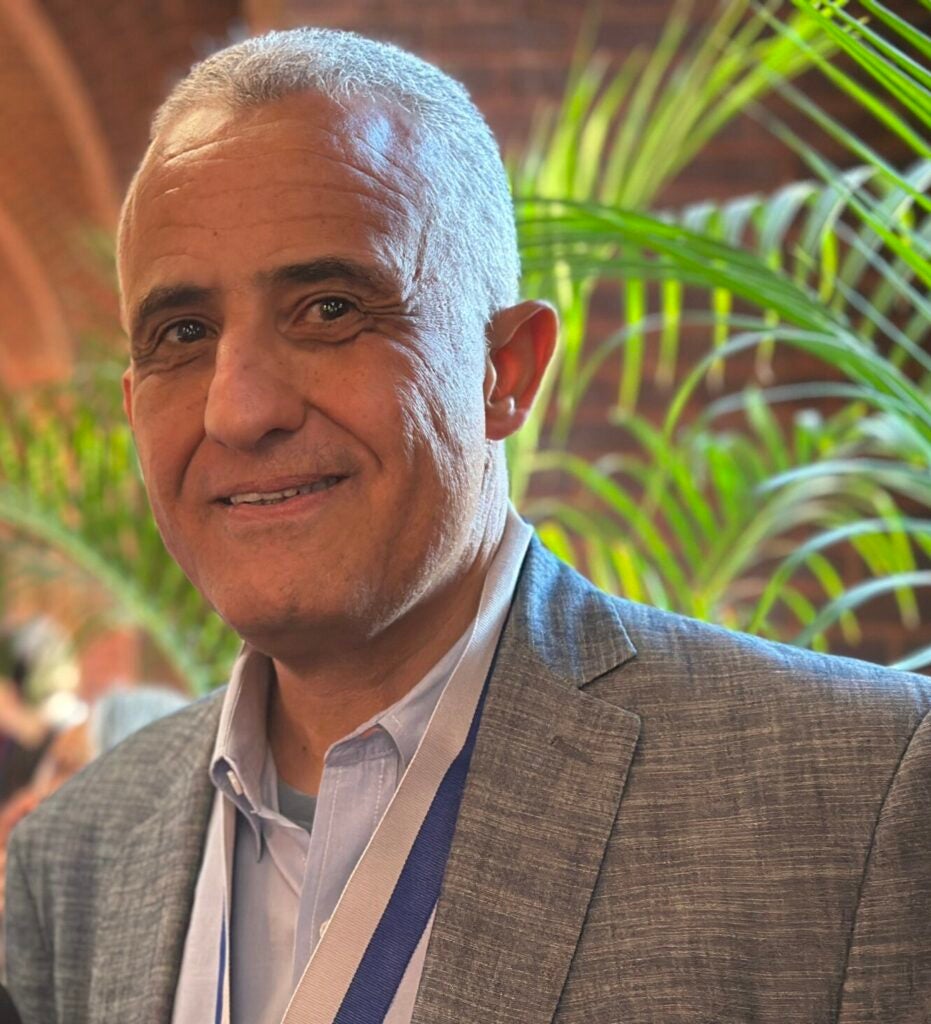
As the Center for Contemporary Arab Studies (CCAS) celebrates its 50th anniversary, I cannot miss this opportunity to pay tribute to the late Michael C. Hudson, one of the co-founders, along with Hisham Sharabi, of this scholarly institution. Hudson’s leadership and scholarship were instrumental in advancing intellectual rigor, multidisciplinary teaching, and critical inquiry, all rooted in a principled tradition of academic freedom, which become the center’s brand of excellence. So far, CCAS is the only academic institution in the United States (along with the Arab-American Educational Foundation Center for Arab Studies at the University of Houston) that reflects on the Arab world as a single geographic unit transcending any attempt at diluting the region into a more ambiguous “Middle East”; a colonial, imperial artefact, coined by outsiders to the region while continuing to (mis)represent so much–even as it means nothing at all. For the last five decades, CCAS has been at the forefront of academic knowledge production, challenging colonial worldviews that shaped the contemporary Arab world. In this cruel time of live-streamed, ongoing genocide against the Palestinian people, there is a need for anti-genocide activism that not only seeks to decolonize knowledge by questioning hegemonic, packaged, linear and mainstream thinking but also historicizing the West and the Arab world without romanticizing the former while acknowledging the latter’s legitimate claims against injustice, colonialism, and orientalism. Decolonizing knowledge should be understood as an open-ended liberation (tahrir) from a colonialism that never ended, as witnessed by ongoing crises and wars across the Arab world. Whereas CCAS reached this momentous milestone with a solid foundation and confidence, it should build on the envisioned legacy of its founders to shape its future. CCAS must further invest in intellectual inquiry while enriching this with suppressed indigenous perspectives in order to empower future generations of graduate students in the realm of ideas. By doing this, students will be able to construct an alternative decolonial framework to the hegemonic theoretical lens structuring the Western field of area studies while advocating for Global South perspectives committed to collective agency, liberation and resistance.
Judith Tucker
Professor Emerita
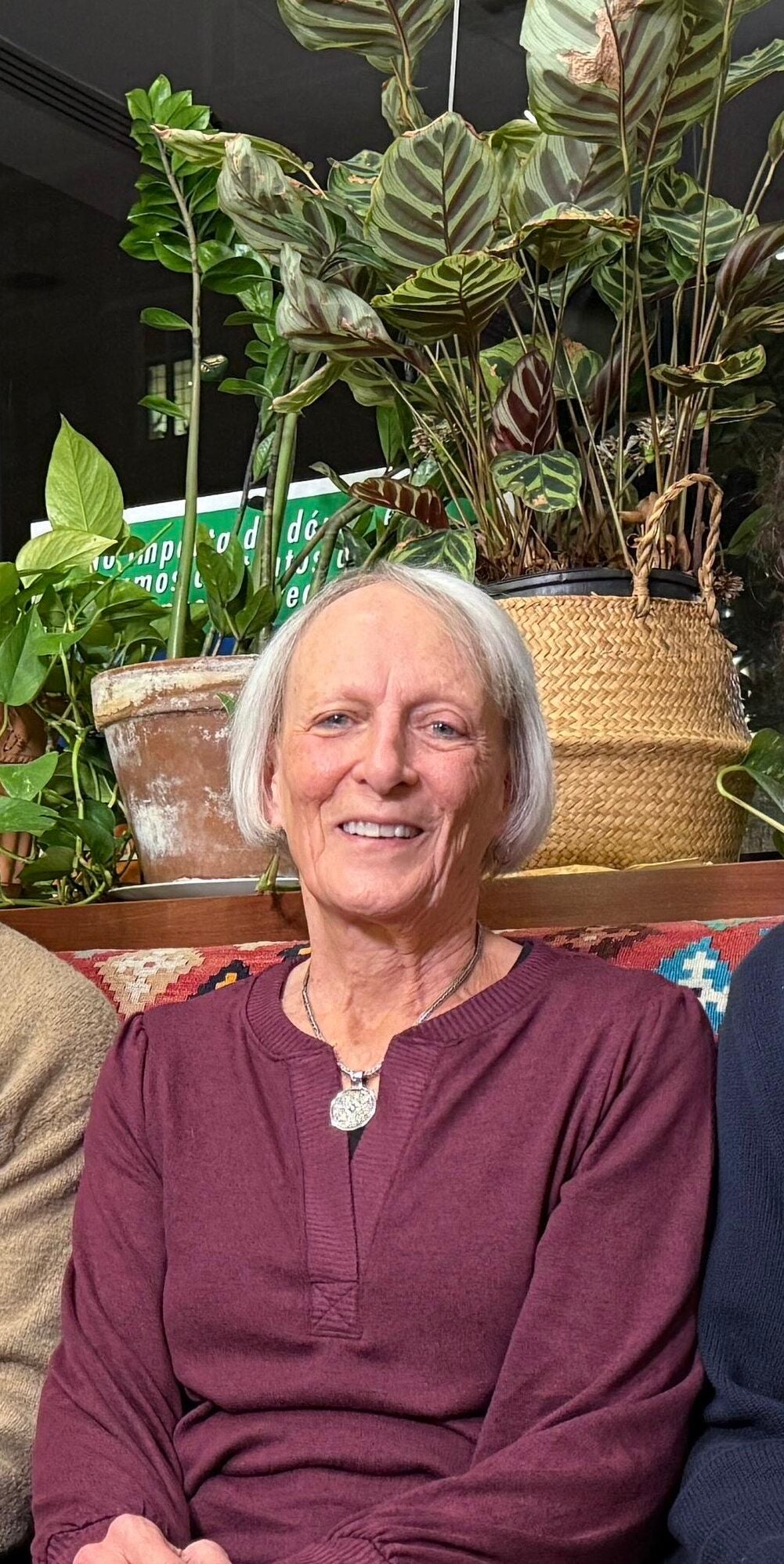
We are in an unprecedented moment when the autonomy and integrity of institutions of higher education, including our own, have come under a series of attacks from our government, threatening the very foundations of academic freedom by trying to dictate what can be said, taught, and learned on campus. I find myself thinking about how CCAS has stayed the course over 50 years in the face of many attempts to curtail academic freedom, to silence the voices of its faculty, students, and visitors when it came to critical analysis of U.S. imperial policies in the Middle East, the imperative of Palestinian self-determination, or even the celebration of Arab culture. What lessons for the future can we derive from this history of steady adherence to scholarship, teaching, and programming that has tried to center the aspirations of the people of the region and eschewed the biases of partisan approaches to the Arab World?
I think CCAS of the future will thrive by following this path of careful attention to, and connection with, the region that has served it so well in the past. Short-term, as the upheavals of authoritarian government at home and imperial adventure abroad continue to play out in the U.S., I expect CCAS to give full support to its faculty as they draw on their deep knowledge of the Arab World to challenge openly and loudly the myopic self-interest and prejudice that is shaping U.S. policy there. And although CCAS students will be graduating in a very troubled time, I have every confidence that they have the analytical tools and the deep ties to the region that will enable them to make a positive difference in whatever sphere they enter.
In the longer term, say over the next 50 years, I have more hopes than expectations. The future of CCAS is wedded to the future of the Arab World and I can only wish for the following: CCAS will be a place political leaders look to as they shape a saner and more just foreign policy; CCAS will be the premier location for the study of a state and society in which Palestinians have full rights; the curriculum and the programming of CCAS will be increasingly focused on the social movements in the region that are sounding the death knell of authoritarianism. In brief, I hope that the optimism and belief in the limitless potential of the Arab World that inspired the founders of CCAS will inform its future as well.
Joseph Sassoon
Professor of History/Political Economy and Sheikh Sabah Al Salem Al Sabah Chair
Looking at CCAS over the next 50 years, my hope is that we continue to attract the best minds interested in studying the region, and that we expand our teaching and research to cover new areas. The region has changed dramatically over the last 50 years, and it is safe to assume it will continue to evolve over the next half-century. Hence, the Center needs to adapt to these changes and become an even more exciting place to study and research.