
The Backbone of CCAS
Staff Remember 50 Years of Camaraderie and Intellectual Inquiry
By Mimi Kirk
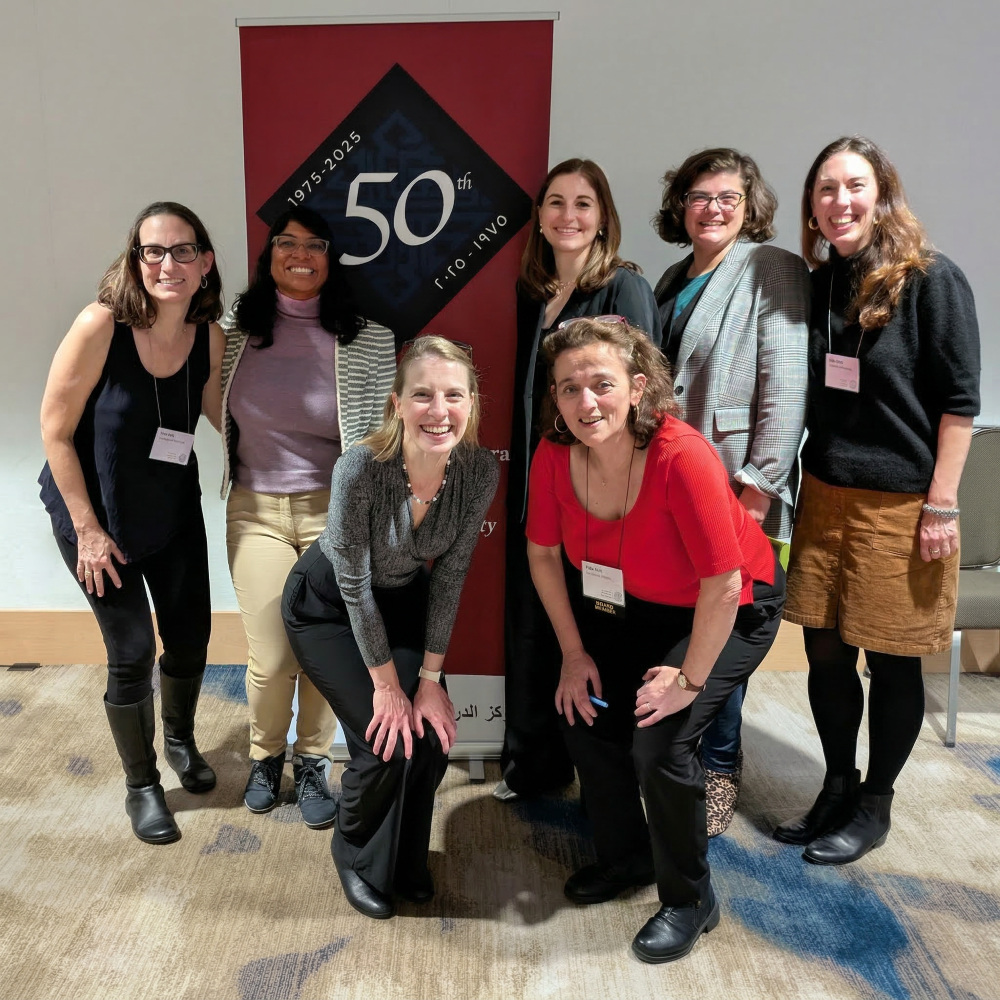
CCAS staff, past and present, at the Center’s 50th anniversary MESA reception (Left to Right): Mimi Kirk, Dharini Parthasarathy,
Vicki Valosik, Fida Adely, Mackenzie Poust, Marina Krikorian, and Kelli Harris
I remember the first day I walked into CCAS, in 2008. I had left academia five years before, thinking I wanted to move into journalism. But my jobs editing mass market magazines, while educational, lacked the critical thinking of the academy and the camaraderie of a like-minded community that can come with it. I applied for the editor position at CCAS and came to the Center to be interviewed by Director Dr. Michael Hudson, Associate Director Rania Kiblawi, and Education Outreach Director Zeina Azzam. We sat at the table in the director’s office, and I recall thinking how much I liked each of them.
I stayed for four years, until Mike asked me to come to the National University of Singapore, where he was heading up a new Middle East Institute. Now, close to 20 years after that first interview, I’m thrilled to be back at CCAS, this time as Associate Director. I think of Mike often – his presence at the Center is so missed – and am grateful to have Zeina and Rania as dear friends.
I reached out to a variety of former CCAS staff and asked them to share what had been both most meaningful and challenging for them at the Center, as well as what they thought had changed or remained constant over the decades. I received close to a dozen responses and immediately noticed common themes, particularly the significance of the work and the family-like atmosphere – elements that are not unrelated.
As Gail Griffith, who was hired in 1978 to get the Master of Arts in Arab Studies (MAAS) program off the ground, said, “Because we were doing something novel, and occasionally controversial, we bonded as though it was family. And once we started gaining students, they were part of this extended family, too.” Griffith adds, “I’m not sure I ever worked anywhere over the course of a 50-year career that demonstrated such camaraderie and dedication to its mission.” Liz Kepferle, Academic Program Coordinator from 1993 to 2005, spoke of her affection for this “sense of family” as well. “No job before or after came close,” she wrote. And Rania Kiblawi, who worked in a variety of CCAS roles from 2003 to 2016, culminating in Associate Director, described a similar impression of “camaraderie and family.” “We all felt like we were doing the work for a higher purpose,” she added.
CCAS has hosted many staff and weathered many storms over the years, no less than in the current period of repression in the American academy and extreme US and US-sponsored violence in the region. Azzam noted that CCAS has historically been a resource in difficult times, with Douglass adding that the Center’s education outreach program expanded over the years to serve educators nationwide, particularly due to its standing as a National Resource Center funded by the U.S. Department of Education. “CCAS flourished under this prestigious position, both in opportunities for public programming and for our work in education outreach,” Douglass said. Azzam recalled that after the events of 9/11, CCAS “was ready to provide information and answer questions, and teachers and community organizations knew to contact the Center for assistance.” Krikorian wrote that in the contemporary moment she has been glad “to see the leadership continually embrace and maintain standards of academic freedom in a climate of scrutiny and censorship.”
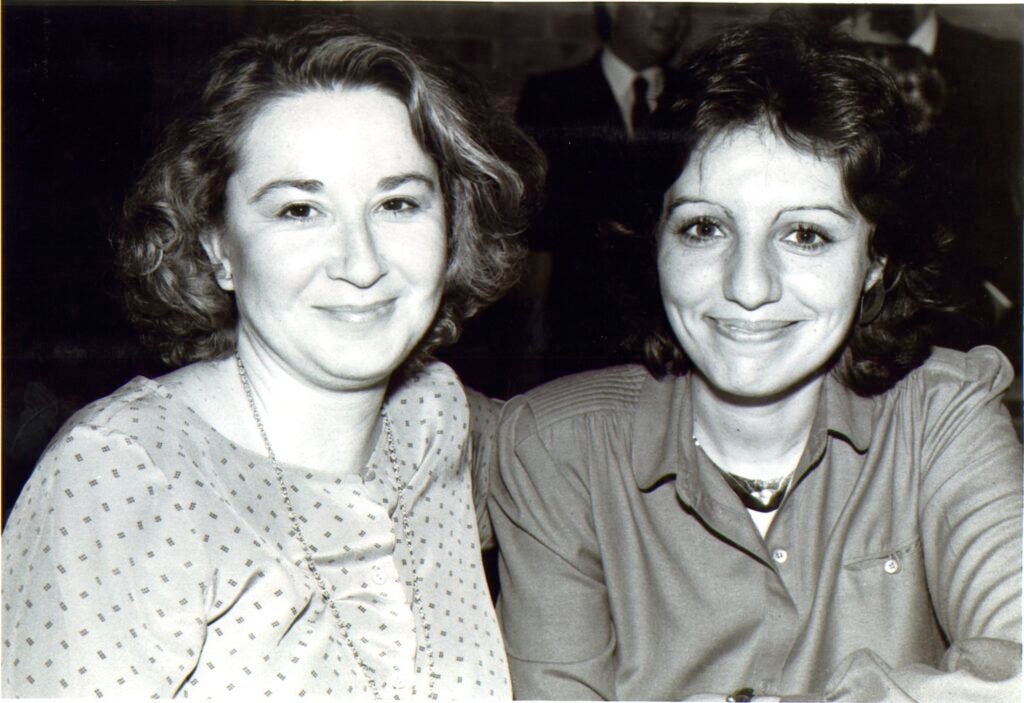
Julie Peteet and Zeina Azzam in the 1980s
Dr. Julie Peteet, who worked as Outreach Coordinator in the early 1980s, remarked that the scholars and visitors coming from all parts of the Arab world, Europe, and beyond made for an intellectually vibrant space. Likewise, CCAS’s role producing critical knowledge and facilitating learning has been particularly meaningful to many staff. Marina Krikorian, Information Officer and then Public Affairs Coordinator from 2009 to 2013, described how grateful she was to have been exposed to sharp and informed analysis every day, and Kepferle noted how much she learned by attending public lectures and talking with students, faculty, staff, and visitors. Zeina Azzam, who worked at the Center on and off (mostly on!) from 1980 to 2013, ultimately as Education Outreach Director, wrote how she grew in skills and knowledge as CCAS itself developed and flourished, and Dr. Laila Shereen Sakr, Multimedia and Publications Editor from 2002 to 2007, built CCAS’s first website and then went on to get a PhD in Media Arts and Practice. In her current position as Associate Professor of Film and Media Studies at the University of California, Santa Barbara, Sakr says she “continues to think critically about the digital humanities and arts in Middle East Studies.”
Kepferle called the Center a “hive of activity.” While this means the many events, visitors, and student initiatives, it also describes a vibrant and sometimes chaotic space, particularly the diwan. Dr. Susan Douglass, Education Outreach Director from 2014 to 2025, shared a not-so-positive memory of when her purse was stolen from her office one day. “The person entered unnoticed through the lobby, which was full of students – often rowdier than CCAS admin appreciated (a consistent theme in staff meetings). Dr. Joseph Sassoon remarked afterward that it must have happened because the Center looked and sounded like ‘like a Baghdad café!’” In true CCAS community fashion, the students immediately took up a cash collection for Douglass so she could get home on public transport.
Staff also mentioned the mentorship they received from supervisors and colleagues. Kepferle wrote that Dr. Judith Tucker, as Director of the MAAS program during her time at CCAS, was the best “boss” she ever had. “Her support and warm guidance made my job easy,” she wrote, “and it made it very, very hard to leave.” Richard Dorn, who served as Assistant Director from 1993 to 1997, worked closely with Director Dr. Barbara Stowasser. “She became a mentor, a source of huge academic knowledge and also of awareness,” he recalled. And Rania Kiblawi and Laila Shereen Sakr both mentioned Michael Hudson and Barbara as “wonderful,” “brilliant,” and “vibrant.” “Mike was always coming up with never-ending and terrific ideas for events, and it was at times overwhelming, but always really, really rewarding,” Kiblawi said.
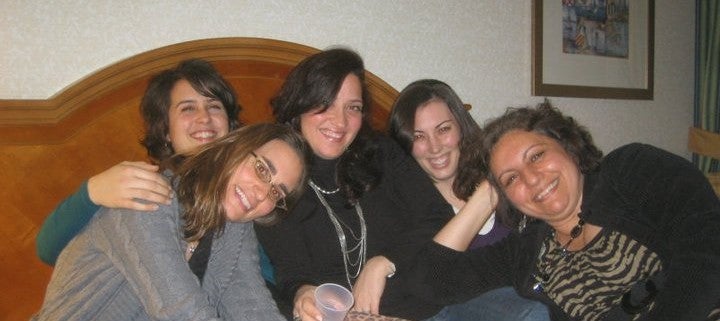
Staff members Maggie Daher, Mimi Kirk, Rania Kiblawi, Kelli Harris, and Zeina Azzam relaxing together during the 2011 MESA
conference
As most of the CCAS staff have been women, another prevalent theme was the Center’s support for motherhood. Peteet mentioned that many staff and faculty were pregnant at the same time during her tenure and recalled that she and another pregnant staffer consumed an entire pizza at a staff lunch. “People were astounded!” she laughed. She added that the community would collect money to give expecting mothers a car seat or a stroller. “Not all places are like that,” she said. And Kepferle said she was particularly grateful that Tucker allowed her to bring her baby to work with her – for six months! – when she returned from maternity leave. “She then tipped me off to the best daycare ever. Family, indeed!” she wrote.
As CCAS celebrates its fiftieth year, I’m proud to be part of this history, and trust that we’ll weather more storms together and emerge stronger than ever in the years to come.
Mimi Kirk is the CCAS Associate Director.