
Identity, Knowledge Production, and Resistance
Reflections from a scholarly roundtable marking 50 years of Arab studies at CCAS and beyond
By Marwa Daoudy
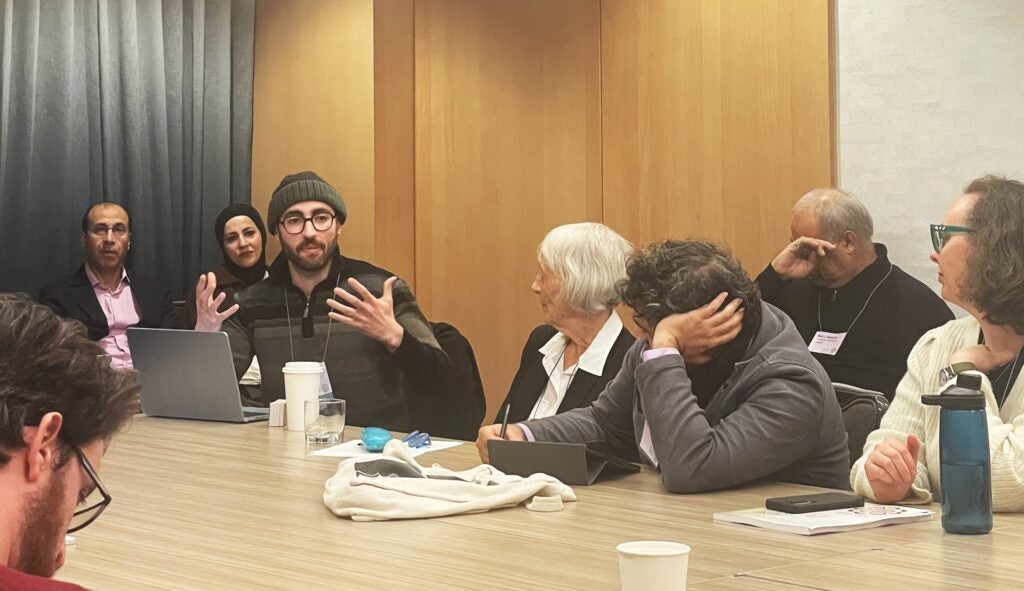
MAAS student Layth Malhis speaks at the MESA panel.
Renowned Arab scholars Hanna Batatu and Hisham Sharabi were among the founding scholars of the Center for Contemporary Arab Studies (CCAS) at Georgetown University in 1975. The Center’s original logo depicting the words “al-Arab al-yawm” (The Arabs Today) embodies a long-lasting vision for Arab studies. CCAS has developed a fifty-year tradition of teaching its graduate students to critically analyze and deconstruct the epistemological assumptions, paradigms, methods, and sources used by social scientists and humanists from and outside the region in the production of knowledge about the Arab world—a production of knowledge shaped by power, politics, and ideology.
As part of the Center’s year-long 50th anniversary commemorations, I organized a roundtable for the 2025 Annual Meeting of the Middle East Studies Association (MESA) titled “Fifty Years of Arab Studies in the US: Identity, Knowledge Production and Resistance from the Center for Contemporary Arab Studies.” This roundtable gathered a multigenerational group of scholars with ties to the Center—including Professor Emerita Judith Tucker, former Qatar Post-Doctoral Fellow Dr. Adey Almohsen, Professor Rochelle Davis, alum Dr. Ziad Abu-Rish, MAAS student Layth Malhis, and myself—to discuss the legacy of Arab and Palestinian intellectual history, the challenges of teaching Arab Studies in times of genocide, settler-colonialism and war, identity, revolution, resistance and the Palestine Question.
A shared set of questions emerged: who produces knowledge about the Arab world, from where, and for whom? Rather than providing definitive answers, the panelists collectively framed Arab Studies as an intellectual, ethical, and political project defined by an enduring tension—one between critique and commitment, scholarship and politics, academic distance and solidarity.
From Tucker’s account of the founding vision and Almohsen’s articulation of intellectual plurality, to my own epistemological and political reflections and Davis’s pedagogical commitments, and to Abu-Rish’s reflections on mentorship and Malhis’s affective and ethical reframing, the roundtable traced a history shaped by both continuity and transformation.
Founding Vision and Intellectual Styles
Judith Tucker set the stage for the discussion by outlining the founders’ vision and providing a conceptual foundation for understanding the historical roots of CCAS. She argued that the establishment of the Center in the 1970s was a distinctive institutional experiment within the American academy and represented a deliberate break from dominant paradigms that shaped the study of the Middle East at the time. This orientation was both intellectual and political: a key goal of the new Center was to contribute to understanding, analyzing, and—importantly—to representing the region. That mission made the Center particularly vulnerable to political pressure, given its alignment with Palestinian liberation. Yet, instead of retreating, faculty, staff, and students have shaped the Center’s intellectual identity through these encounters, reinforcing their commitment to critical and committed scholarship.
This commitment took shape through rigorous Arabic language training, critical reflection on how knowledge about the region is produced, and a sustained effort to center voices from within the Arab world. It also required engaging with issues such as colonialism, nationalism, social inequality, and especially the question of Palestine, not as abstract topics, but as historically situated and politically urgent concerns.
Building on this foundation, Adey Almohsen approached CCAS’s history by contrasting two of its founding figures: Hisham Sharabi (1927-2005) and Hanna Batatu (1926-2000)—both Palestinian scholars. Sharabi was the engaged public intellectual: visible, politically active, and deeply involved in institution-building and debate. Batatu, in contrast, was a meticulous archival scholar, producing deeply researched, foundational work through years of sustained, and often solitary, inquiry. Almohsen noted that these approaches were not as much in opposition as mutually reinforcing, and that their coexistence points to a distinctive strength of CCAS: its ability to accommodate and sustain both public engagement and academic inquiry, allowing scholars to move between these modes rather than privileging one over the other. This balance has enabled the Center to produce scholarship that is both immediately relevant and historically grounded.
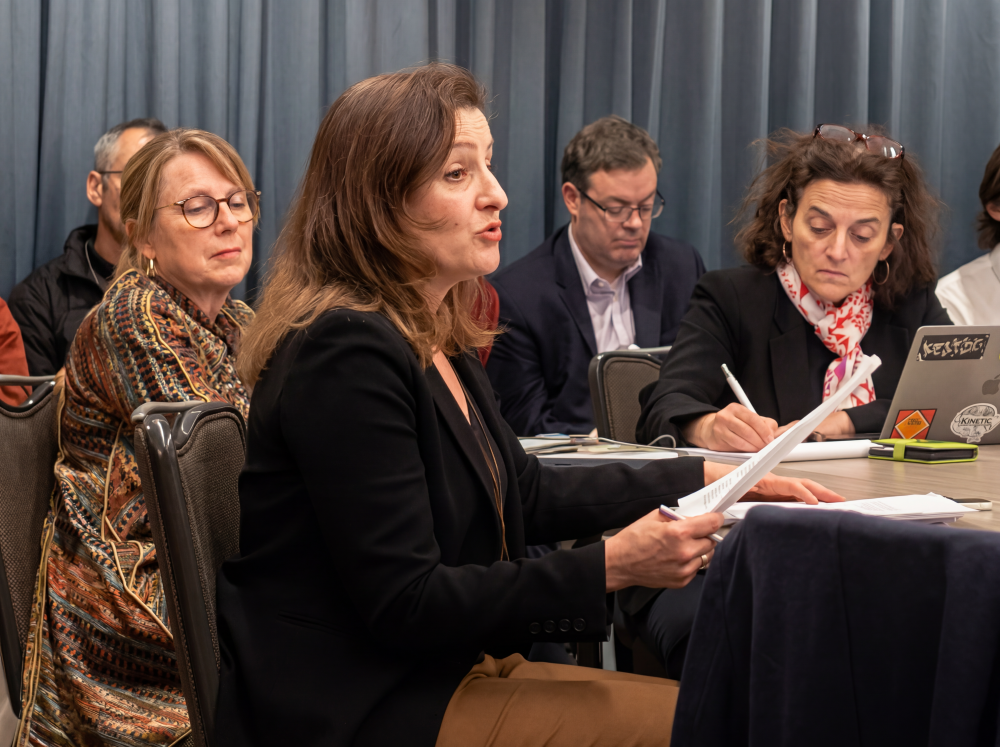
Panel moderator Professor Marwa Daoudy delivering her remarks
Epistemology, knowledge and agency as resistance
Building on the question of representation, I then centered my intervention on the politics of knowledge production as a challenge to dominant framings of the Arab world. Arabs are often relegated to the status of subaltern “others” within racialized hierarchies tied to Western-centric framings of modernity, progress, and rationality. Drawing on the intellectual legacy of one of CCAS’s founders, Michael Hudson (1938-2021), whose chair in Arab Studies I have had the honor to hold, my presentation outlined how he successfully paved the way to reframing U.S. power closer to its reality within the region: an unstable and contested form of hegemony.
Hanna Batatu also taught his students and readers to address social inequalities and injustice. His second and last great work, Syria’s Peasantry, the Descendants of Its Lesser Rural Notables and their Politics (1999), inspired both my most recent book examining the environmental and human security roots of the Syrian conflict, and my forthcoming manuscript on climate security as justice by asking that we understand the rules of ideology, focus on class and inequality, and unveil the root causes of injustice.
I ended by outlining the emancipatory power of knowledge production that has never been more urgent in an era defined by the Gaza genocide, Israel’s ethnic cleansing and settler-colonialism in the Occupied Palestinian Territories, devastating wars in Syria, Sudan and Yemen, and the compounding toll of climate injustices. Teaching, writing, and researching the Arab world from the United States becomes both “exhilarating and daunting” as scholars navigate censorship, political pressure, and hegemonic narratives.
Reframing Area Studies through local voices and pedagogy
Rochelle Davis centered her contribution on the fundamental rethinking of area studies and the distinctive position of CCAS within and beyond this tradition. She argued that CCAS has consistently resisted the core logic of such programs: the production of knowledge about regions in service of American power. Instead, Davis outlined the uniqueness of CCAS, which has moved away from asking “what is happening in the Arab world?” toward asking “how do people in the Arab world understand themselves and their place in the world?” This reframing has situated the region not as an object of analysis but an active producer of knowledge.
Central to this transformation is what Davis described as a “democracy of voice.” At CCAS, this has taken shape through pedagogical practices that foreground Arab intellectual production, prioritize primary sources, and encourage students to engage critically and creatively with the region. Teaching becomes a key site of intervention, where students are not only trained in disciplinary knowledge but also supported in developing their own analytical voices and perspectives.
Pedagogy, mentorship, and the lived making of a field
A grounded experience within CCAS was later offered in Ziad Abu-Rish’s presentation, shifting the focus from institutional vision and epistemological critique to the lived practices that sustain knowledge production. Drawing on his time as a MAAS student, Abu-Rish framed the Center as a transformative intellectual and social space, one shaped as much by everyday interactions and mentorship as by curriculum. Studying with historians, political scientists, and anthropologists showed him how knowledge could be produced through multiple methods and perspectives.
Abu-Rish discussed the value of experiences such as oral examinations that prepare students to communicate ideas across different audiences, moving beyond academic language to engage broader publics. Fostering this skill reflects a core CCAS commitment to bridging scholarship and real-world engagement. He also praised the mentorship and care he received at CCAS, sharing how faculty not only guided his intellectual development but actively helped him navigate setbacks, ultimately enabling his success as a scholar. He ended by pointing to the impact of alumni, both within academia and beyond, as well as alumni-led initiatives like the Arab Studies Journal and the Arab Studies Institute, which have expanded the reach of critical scholarship into public and intellectual life.
The “Arab street” and scholarship as moral practice
Finally, the presentation by Layth Malhis, a second-year MAAS student, brought a generational perspective to the roundtable, framing Arab studies not simply as an academic field but as a deeply moral and emotional practice shaped by the urgency of pressing events. He described studying the Arab world today as a form of longing, a way of holding onto histories, communities, and futures under conditions of fragmentation, violence, and dispossession.
At the center of his intervention was the concept of the “Arab street,” which functions as both a metaphor and method. For him and his peers, it represents a shared commitment to centering lived experience, particularly the lives of those most directly affected by political, economic, and social transformations. Despite grief and fragmentation, he described a collective intellectual space formed among his peers that reflects the founders’ vision of CCAS as a refuge for critical and engaged thought.
Malhis concluded by discussing how a new generation of students and scholars is reimagining the field, navigating both the weight and the possibilities of the present. He situated contemporary crises, especially the Gaza genocide, within a longer colonial genealogy, emphasizing continuity rather than rupture. This perspective also informs his own research, conducted during his time at MAAS, in which he developed the concept of “de-healthification” to capture how the systematic destructions of healthcare infrastructure function as a strategy for dismantling social life itself. By naming and tracing such processes, scholarship becomes an act of witnessing and refusal, challenging narratives that obscure structural violence.
Taken together, all these contributions reveal how Arab studies at CCAS has evolved over the past 50 years as a dynamic intellectual project, one that is less defined by a fixed methodology than by a set of enduring commitments that are continually reinterpreted across the generations represented in the roundtable. Yet the response was not simply critique. It was also prescriptive, calling for alternative frameworks, pedagogies, and communities that enable more accountable and grounded forms of researching, teaching, and experiencing the Arab world—in daunting as well as hopeful times—characterized by a shared sense of community and belonging.
Associate Professor Dr. Marwa Daoudy holds the Seif Ghobash Chair in Arab Studies and is the Director of Academic Programs at CCAS.