
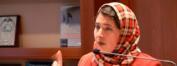
Poet, Writer, and Scholar Dr. Mohja Kahf Visits CCAS
Renowned author and scholar Dr. Mohja Kahf visited CCAS in fall 2008, reading poems and other selections from her literary works and speaking about the stereotype of the oppressed Muslim woman. Born in Damascus, Dr. Kahf is an associate professor of comparative literature at the University of Arkansas. Her books include a novel, The Girl in the Tangerine Scarf (Perseus, 2006), a book of poetry, E-mails from Scheherazad (University Press of Florida, 2003), and a scholarly work, Western Representations of the Muslim Woman (University of Texas Press, 1999). Dr. Kahf’s poems have appeared in Mizna, Banipal, the Paris Review, and the Atlanta Review. She has finished a poetry manuscript about Hajar, Sarah, and Abraham, from which CCAS is pleased to feature a poem below. All Good They see it as far-off, but We see it as near. Quran, The Ways of Ascent 70:6-7 Out in the blue infinitude that reaches and touches us sometimes, Hajar and Sarah and Abraham work together to dismantle the house of fear, brick by back-breaking brick. With a broom of their own weaving, they sweep the last remains away. They sit down for a meal under the naked stars. Ismaïl and Isaac come around shyly, new and unlikely companions. Hajar introduces them to her second and third husbands and a man from her pottery class who is just a friend. Hajar’s twelve grandchildren pick up Sarah’s twelve at the airport. The great-grandchildren appear, set down their backpacks, and tussle to put up the sleeping tents, knowing there will be no more rams, no more blood sacrifice. Sorrows furrow every face. This, in the firelight, no one denies. No one tries to brush it all away or rushes into glib forgiveness. First, out of the woods, shadows emerge: the dead of Deir Yassin, killed by Zionist terror squads, the Kiryat Menachim bus riders killed by Palestinian suicide bomber. They face each other, tense up. Some of them still do not have gravestones. The ghosts of Mahmoud Darwish and Yehuda Amichai begin to teach them how to pronounce each other’s names in Hebrew and Arabic. The poets will have a long night. Meanwhile, a Hamas sniper, a Mosad assassin fall to their knees, rocking; each one cries, “I was only defending my—my—” Into the arms of each, Hajar and Sarah place a wailing orphaned infant. Slow moaning fills the air: Atone, atone. The grieving goes on for untold ages, frenzied and rageful in the immature years, slowly becoming penitent and wise. When an orange grove is given back to its rightful owner, the old family drama finally loses its power, withers, dies. A telling time for new stories begins. Housekeys digging bloody stigmata into the palms of Palestinians cast from their homes turn into hammers and nails for the rebuilding. Despite the abject pain each person here has known, no family that has not lost a child, no one wishes they could change the past because of which we have arrived at this transforming time. Hajar pours water that becomes a subtle, sweet, and heretofore unheard of wine. Sarah laughs again, more deeply. Abraham is radiant. Everyone, this time around, can recognize in the eyes of every other, the flickering light of the Divine. In the very end, in the fourth, unseen dimension that has been here from the very beginning, unfolding just outside the limits of our perception, suffering, not in its rawest form, but distilled in temperate hearts, takes us to higher levels of cognition. Hajar and Sarah, Ismaïl and Isaac, you and I break out of the cycle, Here, Now, to higher life, and it is fine.