
The State of the Middle East: Regional Perspectives and Responses
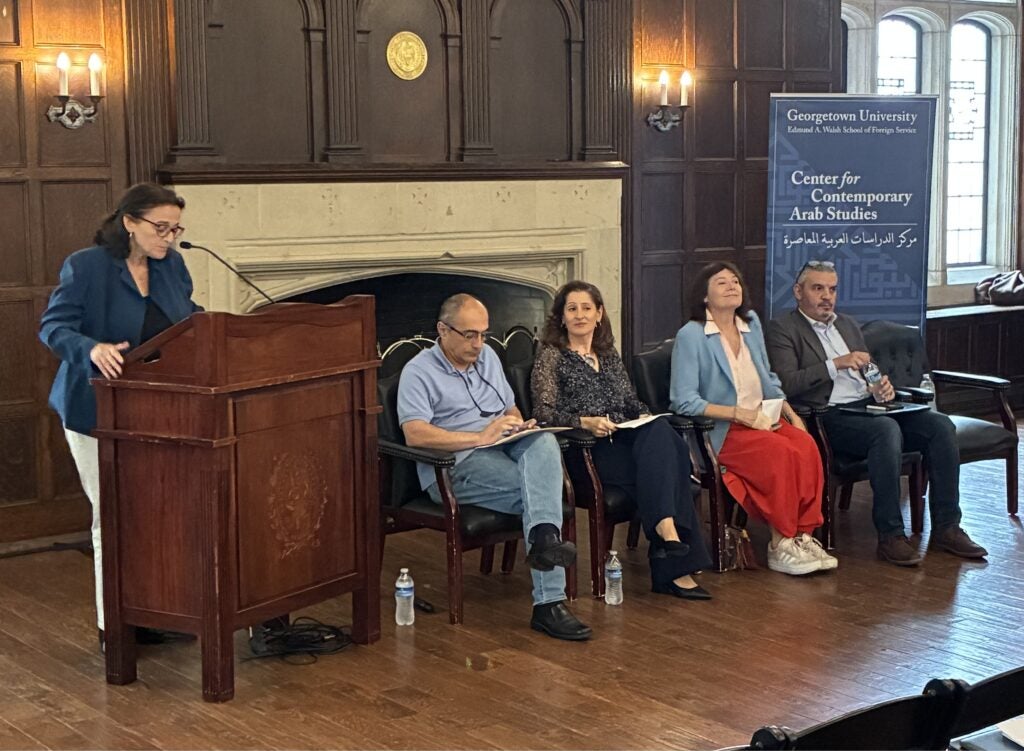
Speakers from left to right: Fida Adely, Nader Hashemi, Marwa Daoudy, Kristin Smith Diwan, and Khaled Elgindy
By Mohannad Shamy
On September 17, 2026, CCAS and the Prince Alwaleed bin Talal Center for Muslim-Christian
Understanding (ACMCU) co-hosted a teach-in, “The State of the Middle East: Regional
Perspectives and Responses,” in Copley Formal Lounge and on Zoom. Moderated by CCAS
Director Fida Adely, the panel examined the U.S.-Israeli war on Iran and the wars on Lebanon
and Palestine, asking what mainstream media and U.S. foreign policy debates leave out.
ACMCU Director Nader Hashemi challenged the portrayal of Iran as the region’s sole
destabilizing force, pointing to the roles of Saudi Arabia, the UAE, Israel, and the United States.
Even the war’s critics, he noted, call it a “war of choice” rather than a “war of necessity,” as if
some wars were necessary. Under the UN Charter, force is lawful only with Security Council
approval or in self-defense. Anything else is aggression, a crime the U.S. debate never names.
Kristin Smith Diwan, Senior Resident Scholar at the Arab Gulf States Institute, explained why
Iranian retaliation has fallen on the Gulf states despite their opposition to the war. Strikes on
energy facilities and airports and the closure of the Strait of Hormuz have hit their hydrocarbon
economies and their ambitions as global hubs, while Saudi, Emirati, and Omani responses have
diverged.
Marwa Daoudy, Associate Professor of International Relations at CCAS, traced the war’s toll on
Lebanon and Syria. She described Israel’s “scorched earth policy” in South Lebanon and its
expanding occupation in southern Syria, asking whether Syrian reconstruction can succeed under
occupation. The war will end, she argued, because of its mounting costs rather than on moral
grounds.
Khaled Elgindy, Adjunct Professor at CCAS, warned that Palestinians face “the single greatest
threat to their continued existence in their homeland since 1948.” He pointed to the near-total
destruction of Gaza and a sharp rise in settler attacks in the West Bank. The United States, he
argued, is no longer a mediator but a participant in the conflict, and he urged Arab and European
states to stop deferring to Washington and act collectively through international law.
A recording of the teach-in can be accessed here.